 FloStor
Scale Without Limits: Replacing Manual Bottlenecks with Robotic Precision
Discover how a leading North American packaging manufacturer transformed its Midwest production facility by replacing manual, error-prone handling with a seamless, automated workflow. By integrating 30 robotic palletizing stations and an intelligent AGV fleet, the facility achieved a dramatic 72% reduction in production floor headcount while eliminating critical shipping inaccuracies. Explore the technical architecture behind this scalable solution that turned an operational bottleneck into a predictable, high-speed powerhouse.
From Manual Bottlenecks to Automated Precision: How Integrated Robotics Built Scalable Throughput for a Leader in Sustainable Packaging
The Client: A Leading North American Manufacturer of Sustainable Packaging Solutions
Imagine a primary producer of high-volume plastic parts, a company that serves as a critical link in the global supply chain by providing essential packaging components. Operating out of the American Midwest, they are a cornerstone for industries requiring massive quantities of durable, sustainable plastic products.
Starting in 2014, this manufacturer partnered with FloStor Engineering to modernize their material handling infrastructure. At the time, their facility managed 24 production machines, each outputting approximately 900 pieces per minute. With a case capacity of 1,800 pieces per carton, the facility was a high-speed environment where even minor inefficiencies in the packaging and palletizing stages could lead to significant operational gridlock.
The Challenge
As the demand for sustainable packaging grew, the manufacturer faced a classic scaling challenge: their manual post-production processes could no longer keep pace with the sheer volume of parts being generated by their machines. The existing workflow relied heavily on human intervention, which introduced both physical bottlenecks and quality control risks.
The Bottlenecks of Manual Processes
- Labor-Intensive Post-Production: Once a carton was filled at the production machine, it was discharged to a manual workstation. Here, workers were required to manually un-cuff the inner liners, seal the cases, apply labels, and palletize the finished goods. Wrapping the pallets with plastic sheeting was also a manual floor-level task.
- Logistical Inaccuracies: The operation ran three shifts with approximately 18 workers per shift, yet the manual nature of the sorting led to frequent errors. It was common for cartons destined for one customer to end up on another customer’s pallet, creating significant customer service issues and eroding trust.
- Traffic and Handling Delays: The reliance on human operators to manually remove full pallets and transport them to the warehouse via forklifts or pallet jacks created a stop-and-start momentum. This lack of a continuous, automated flow meant that the facility’s output was often limited by the speed of manual handling rather than the speed of production.
The Solution
Recognizing that their manual systems had reached their limit, the manufacturer sought a fundamental shift in how they moved and managed their products. They needed a partner who could look at the entire operation—from the machine discharge to the final warehouse put-away—and design a cohesive, intelligent system.
FloStor partnered with the manufacturer to engineer an automated material handling system that integrated existing equipment with cutting-edge robotics and autonomous vehicles.
Engineering the Flow: A System Designed for Control
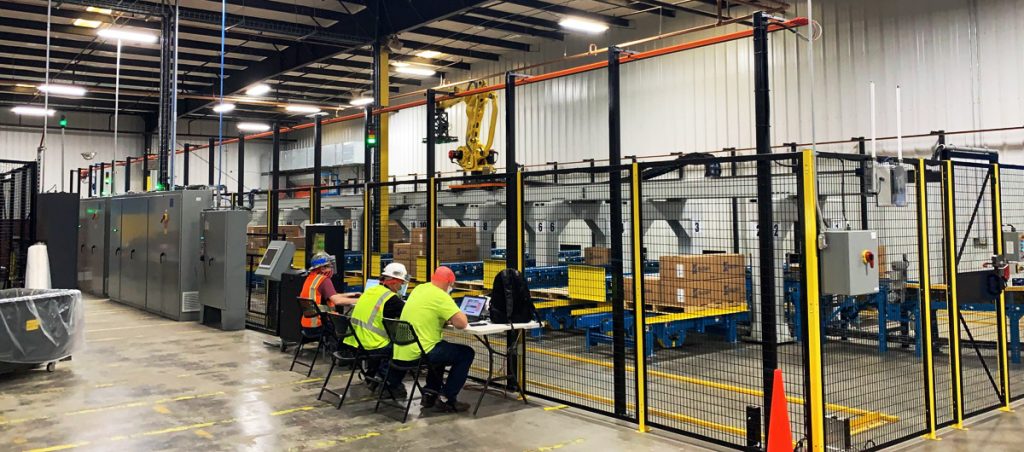
The new solution transformed the facility into a highly controlled, automated environment. The system was designed to take the product directly from the “fill” position and guide it through a series of automated checkpoints without requiring manual touches.
Systems Used
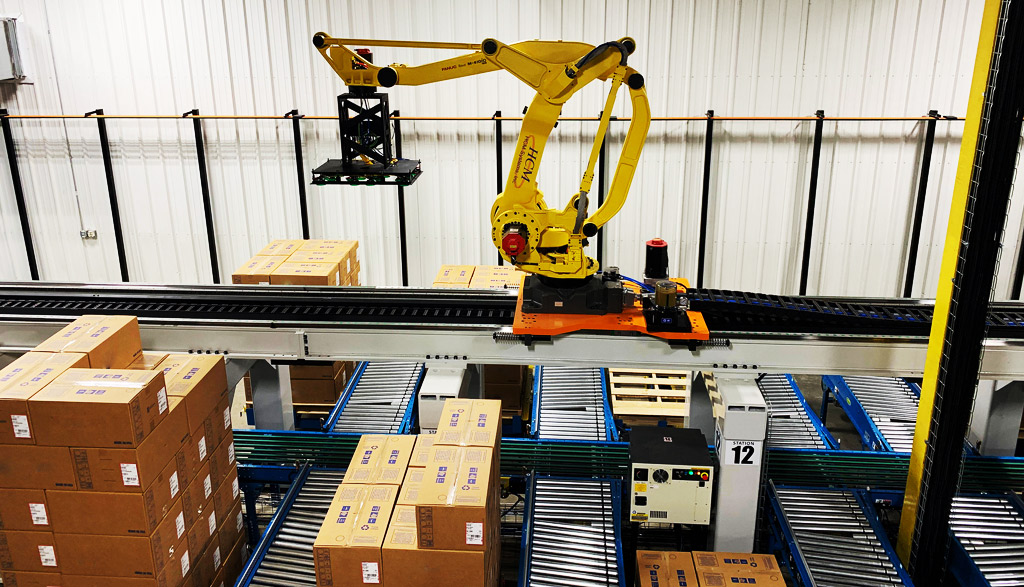
- Integrated Take-Away Conveyor: Automated carton transport system bridging production discharge to final preparation, incorporating existing box formers and bag inserters.
- Automated Preparation & Labeling: Destination labels automatically applied at discharge; conveyor routes cartons to Bag Uncuffer and Case Sealer for automation-ready staging.
- Robotic Palletizing Stations: 24 dedicated robotic arms palletizing finished cartons, scaled to 30 stations as production volume increased.
- Autonomous Guided Vehicles (AGVs): Intelligent fleet supplying empty pallets to robotic stations and retrieving full pallets for automated stretch wrapping, eliminating manual forklift congestion.
The Power of Integration in Action
FloStor’s role as the integrator was critical in weaving together diverse technologies—robotic arms, automated labeling, case sealers, and AGVs—into a single, unified workflow engine. By automating the transition from the machine to the warehouse, FloStor eliminated the “assembly guesswork” and human error that previously hampered the facility.
The Results
The flexibility and control offered by the automated conveyor and robotic palletizing systems transformed the manufacturer’s production floor into a predictable, high-efficiency powerhouse. By partnering with an experienced system integrator, the client achieved a dramatic shift in both operational accuracy and fiscal performance.
Key Performance Gains
- Labor Efficiency: 18 → 5 workers per shift (72% reduction)
- Accuracy: Eliminated customer service errors from misrouted cartons
- Scalability: Facility expanded 25% with system already in place
- Replication: 3 additional systems deployed at other facilities
Why This Worked
The success of this implementation wasn’t about simply “buying more robots.” It was about understanding the complete workflow and designing an integrated system where each component amplifies the others. Here’s why this approach delivered results:
- End-to-End Workflow Integration: Rather than automating isolated tasks, FloStor engineered a continuous flow from machine discharge to warehouse storage. This eliminated the stop-and-start delays that limited production speed.
- Reliability Over Cost: Each system component (conveyors, palletizers, AGVs) was selected and configured to work as one cohesive unit, not as standalone solutions. This synchronization ensured predictable 24/7 operation.
- Operator Reduction Without Chaos: The 72% labor reduction was possible because the system removed the dependency on human judgment. Automated labeling, sorting, and palletizing eliminated the manual decision-making that previously bottlenecked the line.
- Built for Growth: The modular design allowed the client to expand from 24 palletizing stations to 30 without redesigning the entire system. This flexibility paid dividends when the company needed to scale.