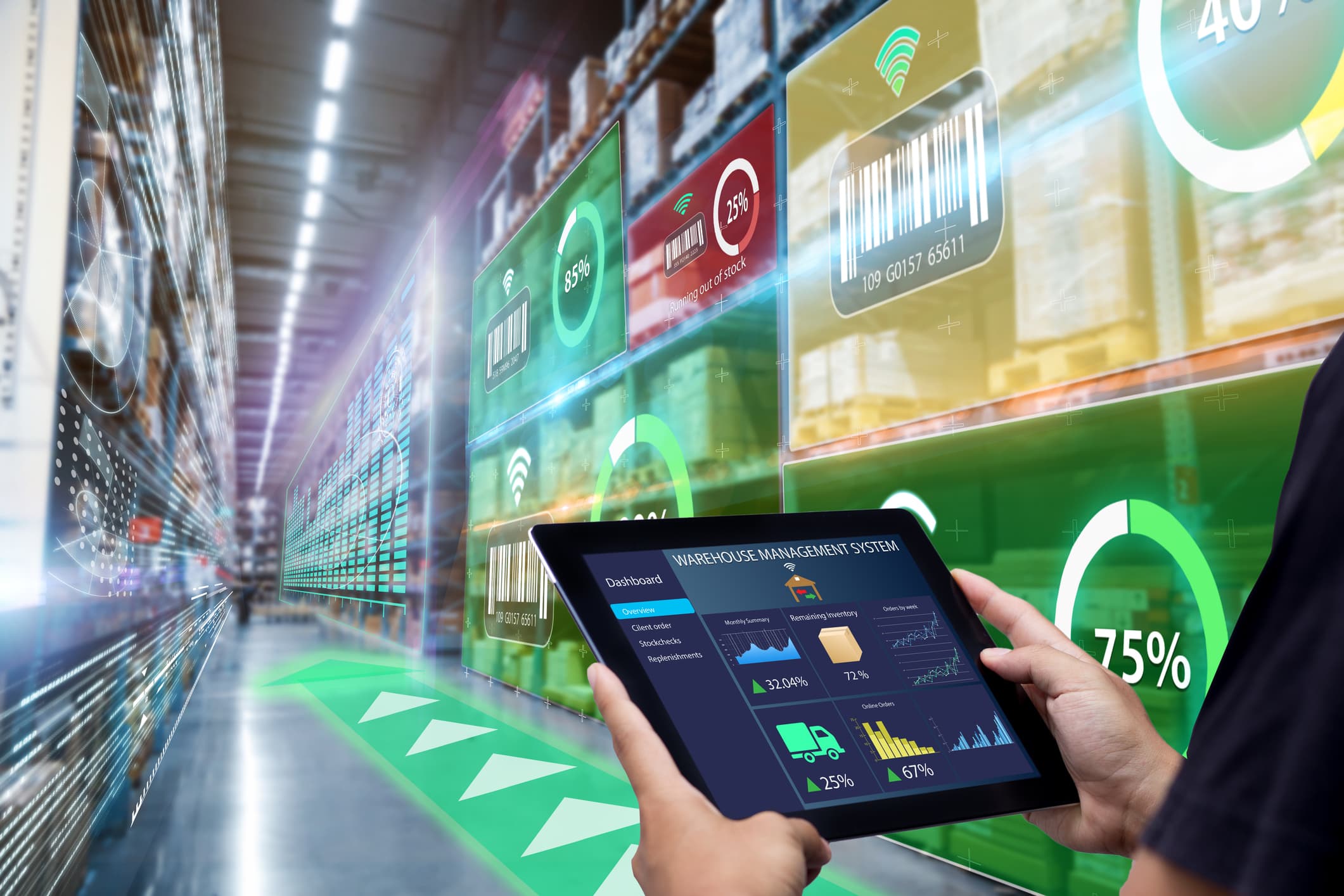
The most robust physical material handling equipment is only as capable as the software logic directing it. Without a unified intelligence layer, automated facilities devolve into isolated islands of machinery—capable of moving fast, but unable to adapt to real-time disruptions.
FloStor's intelligence solutions bridge the critical gap between mechanical hardware and executive data visualization. From warehouse control systems that eliminate systemic bottlenecks to digital twin simulation software that de-risks CapEx investments before installation, we build the software infrastructure that secures your operational ROI.

True operational intelligence requires three distinct software layers communicating in microseconds to translate executive goals into physical action.
The "What": The macro-level brain tracking inventory, managing procurement, and processing raw customer orders. It determines what needs to ship, but not how to move it.
The "How": The operational bridge. It ingests order priorities from the WMS and algorithmically maps the most efficient physical path, balancing workloads across robotic and conveyor zones to prevent jams.
The "Health": The central nervous system directly wired into the hardware. It translates WCS commands into motor actions while feeding back real-time vibration, heat, and fault data to predict maintenance needs.
Explore the software and control frameworks engineered to power operational excellence and executive visibility.
The centralized intelligence layer that balances automated workloads in real-time. Prevent isolated bottlenecks and maximize the ROI of your physical infrastructure by dynamically routing workflows.
Learn MoreDecentralized neural networks providing real-time facility telemetry. Predict and prevent mechanical degradation before it halts operational throughput using advanced sensor arrays and logic controllers.
Learn MoreAlgorithmic physics engines that build digital twins of your facility footprint. Emulate peak-season stress and validate ROI throughput tolerances before a single piece of steel is procured.
Learn MoreDynamic execution frameworks that synchronize outbound fulfillment. Prioritize high-margin or expedited orders algorithmically to protect SLA compliance and maximize daily dispatch velocity.
Learn MoreEradicate data silos. Monitor holistic facility health, throughput rates, and labor allocation via centralized, intuitive executive dashboards.
Shift from reactive manual management to proactive, data-driven control logic that automatically routes around physical line disruptions.
Protect capital investments by mathematically validating system designs through 3D emulation physics before committing to physical builds.
Deploy open-architecture software platforms designed to seamlessly ingest future robotics or evolving ERP systems without costly tear-downs.
Throughput capacity unlocked purely by eliminating idle hardware states through dynamic WCS workload balancing.
Reduction in design risk secured by running millions of digital twin simulations to stress-test layouts prior to CapEx approval.
Operational uptime maintained via predictive SCADA telemetry that flags component degradation before catastrophic failure.
ROI acceleration realized when an intelligent orchestration layer transforms static hardware into an adaptable ecosystem.
Software is the differentiator between a depreciating hardware liability and an appreciating facility asset. Evaluate integration partners on these three systemic capabilities:
Never accept spreadsheet throughput estimates. A modern integrator must utilize algorithmic digital twins to prove system viability under your exact peak-season historical data profiles before hardware procurement.
Ensure your facility logic isn't locked into proprietary, closed-loop OEM software. Demand open-architecture Control Systems (WCS/WES) that allow you to seamlessly interface with any future robotic vendor or warehouse management suite.
Maintenance should be mathematically predicted, not reactively scheduled. Ensure the system architecture includes robust SCADA integration capable of feeding real-time vibration and thermal analytics to central dashboards to prevent unplanned downtime.
| Specification | Value | Notes |
|---|---|---|
| Data Integration | WMS, WCS, ERP, Equipment, Scanners, RFID | Real-time streaming via APIs, batch loads, or edge processing |
| KPI Dashboards | 50+ pre-built metrics | Throughput, labor, equipment, inventory, quality, compliance |
| Reporting Latency | Real-time to sub-minute seconds to minutes | Depends on data source and metric complexity |
| Deployment | Cloud-native, On-premise, Hybrid | Flexible options based on data governance requirements |
Request an Operational System Audit. Let our software engineers evaluate your existing control layer, identify routing bottlenecks, and architect a digital framework designed for scalable throughput.
Request a Software Architecture Assessment FloStor